
An EPR fee estimate becomes unreliable when a design label substitutes for a scheme classification. Build the estimate from the applicable market and year, the package’s component record and the official fee rules, then test whether the design change alters those inputs.

Set the jurisdiction and fee year
There is no single worldwide packaging EPR rate. Before estimating anything, identify the market, the responsible entity, the reporting period and the packaging scope. A supplier’s statement that a material is recyclable cannot answer those questions.
This article uses the United Kingdom’s household-packaging disposal-fee system as a bounded example. It does not establish whether your organization is obligated. Check the official EPR collection and the guidance that applies to your reporting year before using a fee model.
PackUK’s published base-fee explanation describes recyclability-based modulation from the second year of the scheme. The historical rates on that page are not current quotations for every later period. Keep rate selection and recyclability assessment tied to the same applicable rules.
Create a component record before calculating
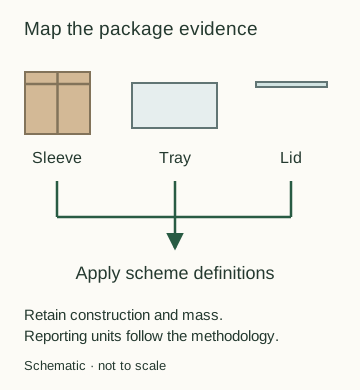
Treat each defined packaging unit or component according to the applicable methodology. Do not assume that every physically separable layer is a separately reportable component. The classification rule determines the accounting treatment; the construction record supplies the evidence.
| Record field | Evidence to retain | What a design change might affect |
|---|---|---|
| Market and reporting period | Official guidance version and supply record | Which obligations and rates apply |
| Packaging unit or component | Drawing, bill of materials and methodology definition | The assessment boundary |
| Material and mass | Supplier composition record and measured/documented mass | Category and reported quantity |
| Recyclability result | Applicable assessment with supporting evidence | Modulation treatment, where relevant |
| Fee calculation | Official schedule, units and calculation date | The monetary estimate for that period |
| Uncertainty | Named owner and unresolved document | Whether the result is ready for approval |
Keep a document reference in each row. A mass with no unit, or a material code copied from an earlier construction, can produce a precise-looking but unusable total.
Compare the whole change
A redesign can change both the amount of material and its classification. Recalculate those effects separately. First compare the reported quantity on a consistent unit basis. Then apply the relevant published fee treatment to each scenario. Do not count a hoped-for lower rating until the assessment supports it.
The RAM supplementary guidance says assessments need review when design, manufacture, composition or the methodology changes in a way that may alter the result. It also distinguishes assessment from recyclability labelling. A fee classification is therefore not an all-purpose consumer disposal statement.

Use a versioned record: old construction, proposed construction, assessment date, applicable methodology and the person responsible for review. If evidence is missing, show the estimate as a scenario with an unresolved input. Do not silently give unknown material the most favorable treatment.
Copyable component-fee worksheet
Copy the blank records for each scenario, then repeat the component table for every reportable component or material category. This models the selected UK household-packaging disposal fee after you have established the obligated quantity and classification. It does not determine liability or calculate every EPR-related charge.
The official 2025 to 2026 fee explanation expresses the fee in pounds per tonne. Use the dated, applicable final fee for the year and classification being compared. The historical schedule establishes the unit basis here; its numbers are not supplied as current rates.
| Scenario definition | Existing construction | Proposed construction |
|---|---|---|
| Market, obligated entity and fee year | ______ | ______ |
| In-scope supply period and quantity record | ______ | ______ |
| Package / construction revision | ______ | ______ |
| Assessment methodology version / evidence ID | ______ | ______ |
| Official final-rate URL, version and publication date | ______ | ______ |
| Calculation date and reviewer | ______ | ______ |
| Component calculation field | Existing construction | Proposed construction |
|---|---|---|
| Component / material category / assessment result | ______ | ______ |
| Q: in-scope supplied units for this component | ______ units | ______ units |
| c: number of these components per supplied unit | ______ components/unit | ______ components/unit |
| m: mass of one component | ______ g/component | ______ g/component |
| T: chargeable mass in tonnes = Q × c × m ÷ 1,000,000 | ______ tonnes | ______ tonnes |
| F: applicable final fee, with rate source/version | ______ £/tonne | ______ £/tonne |
| D: component disposal fee = T × F | ______ £ | ______ £ |
| Scenario result | Existing construction | Proposed construction |
|---|---|---|
| Total selected disposal fee = sum of component D values | D_old = ______ £ | D_new = ______ £ |
| Difference over the same period | Reference | D_new − D_old = ______ £ |
| Other charges excluded from this model | ______ | ______ |
| Missing input or disputed classification | Evidence / next action | Owner and review date |
|---|---|---|
| ______ | ______ | ______ |
There are 1,000,000 grams in a metric tonne. If your starting record already gives chargeable tonnes, enter that figure as T with its evidence instead of converting it again. Q must cover the in-scope supply identified for that component, rather than all units manufactured. Do not add both a composite item’s whole mass and the same mass split into layers; follow the scheme’s reporting boundary.
F is the applicable final rate after any treatment required by the selected year’s rules. Do not apply another assumed recyclability multiplier to a rate that already includes it. Leave F or T blank while its supporting evidence is unresolved; a blank is not zero. The comparison holds the reporting period and scope constant, so a change in sales volume does not masquerade as a design saving.
Keep disposal fees separate from production savings
Even if a redesign changes the relevant disposal fee, it may require tooling, trials, new consumables or a different operating window. Put those in the investment comparison rather than hiding them inside the EPR line. A design should still meet product-protection and production requirements.
The recyclable-packaging cost worksheet provides that wider boundary. Return to packaging EPR when the next task is assembling the reporting evidence rather than comparing machine performance.
Methods and limits
This is an editorial record-building method. The cited UK pages explain the example’s framework; no fee rates, legal thresholds or assumed discounts are supplied here. Rules and methodologies can change by period. Use the current official documents for your case, and obtain scheme-specific advice where classification or responsibility is uncertain. Checked October 2026.