Compare recyclable-packaging options by the cost of delivering accepted, protected product. A cheaper purchased pack can create a higher production cost if it adds scrap, changeover work or product loss; a higher material price can also be offset by documented savings elsewhere.

Define the same job for both alternatives
Write a comparison boundary before collecting quotes. State the product, protected quantity, distribution conditions and acceptance criteria. Keep the comparison period and product mix consistent. If one option needs an additional insert, label or outer pack, include it in that option’s bill of materials.
Cepi’s guidance places product protection alongside recycling compatibility and points readers toward national systems. That is a useful boundary for a paper-packaging alternative: do not assign a recycling benefit without the appropriate route evidence, and do not remove protection requirements to make a candidate appear cheaper.
The worksheet below is a decision model. It does not supply market prices, typical premiums or assumed machine performance.
Build a cost record that a colleague can audit
Compare recurring production costs on the same accepted-output basis. Keep one-time conversion work visible beside that comparison. If you spread conversion costs over a forecast volume, state the volume and time period rather than presenting the result as an inherent material property.
| Cost or evidence item | Existing construction | Proposed construction | Source to attach |
|---|---|---|---|
| Whole-pack materials | Actual usage and delivered price | Equivalent scope and commercial terms | Bill of materials, quote or invoice |
| Normal conversion work | Labor, utilities and routine consumables | Measured or trial-based assumptions | Batch and production records |
| Rejects and product losses | Observed loss on the defined boundary | Trial result or explicit unresolved assumption | Counts and disposition records |
| Changeover and cleanup | Actual time and material issued | Trial observation for relevant formats | Changeover record |
| One-time work | Separate from recurring total | Tooling, engineering, trials and qualification | Approved project scope |
| End-of-life evidence | Route and assessment status | Same market-specific check | Dated primary evidence |
Do not turn an unknown into zero. An untested scrap rate should remain a scenario input with an owner, not a claimed saving.
Copyable cost-per-accepted-pack worksheet
Copy these blank tables for the same product-protection task and period. Record the currency and each quantity unit. Keep mutually exclusive cost inputs so that material, labor or loss already charged in one row is not added again elsewhere.
| Comparison boundary | Existing construction | Proposed construction |
|---|---|---|
| Product, pack revision and protection / acceptance rule | ______ | ______ |
| Batch or comparison period and product mix | ______ | ______ |
| Currency and cost view: accounting or incremental cash | ______ | ______ |
| Material quantity units and stock-adjustment basis | ______ | ______ |
| Evidence revision / calculation date | ______ | ______ |
| Mutually exclusive recurring input | Existing construction | Proposed construction | Evidence / units |
|---|---|---|---|
| M: packaging material consumed, including its setup/reject usage once | ______ | ______ | Quantity × delivered rate; currency ______ |
| P: normal conversion labor, utilities and consumables | ______ | ______ | Hours or quantity × stated rate; currency ______ |
| X: additional changeover / cleanup not already in M or P | ______ | ______ | Hours or quantity × stated rate; currency ______ |
| L: additional product-loss / rework cost not already charged above | ______ | ______ | Recorded loss basis; currency ______ |
| E: selected disposal fee, if included in this boundary | ______ | ______ | Matched-period fee record; currency ______ |
| Calculation | Existing construction | Proposed construction |
|---|---|---|
| Recurring total R = M + P + X + L + E | R_old = ______ | R_new = ______ |
| Accepted output N in the same period | N_old = ______ packs | N_new = ______ packs |
| Recurring cost per accepted pack C = R ÷ N | C_old = ______ / pack | C_new = ______ / pack |
| Recurring difference per accepted pack | Reference | C_new − C_old = ______ / pack |
| One-time conversion work K, outside R | ______ | ______ |
| Forecast accepted volume V and allocation period, if used | ______ packs; period ______ | ______ packs; period ______ |
| Optional one-time allocation per pack A = K ÷ V | A_old = ______ / pack | A_new = ______ / pack |
| Optional scenario cost per pack S = C + A | S_old = ______ / pack | S_new = ______ / pack |
| Optional scenario difference | Reference | S_new − S_old = ______ / pack |
| Unresolved input / source missing | Could it change the choice? | Evidence or next action | Owner / review date |
|---|---|---|---|
| ______ | ______ | ______ | ______ |
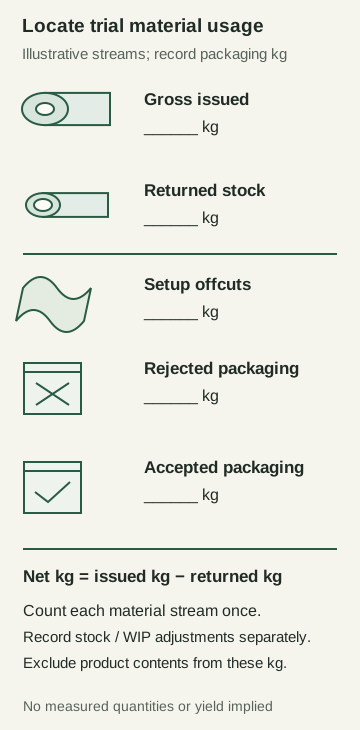
Use M after documented returns and stock adjustments. If actual material consumption already includes setup offcuts and rejected packaging, those amounts stay in M; do not add them again to X or L. Use only additional changeover time in X when P excludes it. Product contents lost in a reject may belong in L, while the same reject’s packaging remains in M. State those boundaries in the evidence column.
Leave unknowns blank; enter zero only when the boundary and evidence support it. Calculate C only when N is greater than zero and the optional allocation A only when V is greater than zero. Keep the selected fee E out of other rows. K stays outside recurring R even when you show its separate forecast-volume allocation. A negative new-minus-old difference indicates a lower modeled cost on this stated basis, not a measured saving.
Count material that never becomes an accepted pack
Material consumption includes startup, setup and rejects as well as accepted output. Reconcile issued material with returns and loss where practical. State whether an invoice price already includes freight or other charges before adding those costs again.
Syntegon’s flow-wrap article connects process stability with fewer rejected products and explains that alternative films can require sealing adjustments. That supports investigating conversion losses. It does not establish a scrap percentage or a retrofit cost for your operation.
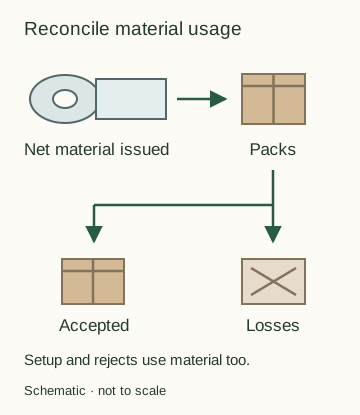
Use the material ledger to locate usage, and the accepted/loss diagram to define the output boundary. Neither supplies a yield benchmark. If the line reports rejected packs but the material record reports roll mass, keep the units separate until you have a documented conversion. Do not compare one option per purchased unit and the other per accepted unit.
Test the assumptions that could reverse the choice
Start with the assumptions that are both uncertain and influential. A trial may resolve material usage or restart losses. A revised supplier scope may resolve tooling cost. A collector’s instructions may show that the claimed recycling route does not apply to the package’s discard condition.
Run a lower-volume scenario if the business case depends on spreading conversion work over future demand. Separate releasable cash savings from capacity that becomes available but is not yet sold. A reduction in operator attention may be valuable without producing a payroll reduction; describe what the team can do with that time.
Record a conditional decision: proceed, revise the design, gather missing evidence or retain the existing construction. List the evidence required before the choice changes. The paper recyclability guide helps test route assumptions; the EPR record isolates the reporting and fee calculation. Both sit within recycling economics.
Methods and limits
The model is original editorial guidance based on the cited material and process explanations. It is not a lifecycle assessment, a supplier quote or a forecast of recycling revenues. No costs, yields or savings have been measured by this publication. Checked October 2026.