Seal initiation temperature is useful only when its test conditions and pass criterion travel with the number. Treat it as a laboratory threshold for a defined material and method, then establish the production window on the actual equipment.
Ask what “initiation” means in the report
A supplier’s onset value needs a stated definition: what seal-strength criterion was met, how the sample was prepared and under which conditions. Without that information, two quoted temperatures may describe different tests. A lower number alone does not establish a better film for your package.
Request the sample construction and lot, sealing method, dwell time, pressure, specimen geometry, cooling interval and strength-test setup. Record the temperature measurement location. A controller setpoint describes the machine’s control system; it is not automatically the temperature reached between the two sealant surfaces.
The public ASTM F2029 scope describes laboratory heat-seal preparation and heat-sealability measured by seal strength. It explicitly separates that work from hot tack, seal-continuity tests and production validation. This guide uses only that public scope, not unpublished clauses of the paid standard.
Compare conditions before comparing values
Put both supplier results on the same worksheet. Mark missing fields as unknown rather than assuming that a familiar method name makes all settings identical.
| Field | Material A | Material B | Why retain it |
|---|---|---|---|
| Construction and lot | Fill from report | Fill from report | Makes the threshold traceable to the tested material |
| Initiation criterion | Strength threshold and unit | Strength threshold and unit | Establishes what “starts sealing” means |
| Seal preparation | Method, dwell, pressure | Method, dwell, pressure | Identifies conditions that may explain a difference |
| Measurement point | Defined location | Defined location | Prevents mixing setpoint and interface assumptions |
| Post-seal evaluation | Delay, geometry and method | Delay, geometry and method | Separates hot behavior from cooled performance |
| Sample evidence | Report and sample IDs | Report and sample IDs | Allows later comparison with the line trial |
If a missing field could change the interpretation, request the full report before using the value to select operating conditions. A technical data sheet can be a useful lead; it is not a substitute for a test definition. For an example of conditional reporting, Jindal’s published product table places its minimum-sealing-temperature entry alongside a strength criterion, pressure, dwell and jaw conditions. Those conditions belong to that product entry.
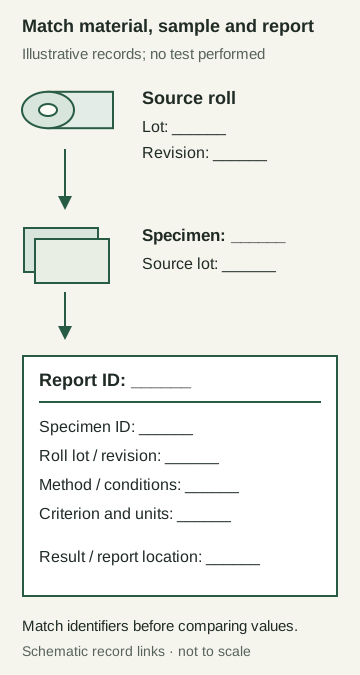
Keep the specimen ID linked to the source roll lot, construction revision and report. The suggested record linkage below helps you identify which material a result describes; it is an editorial method, not a prescribed labelling standard.
Locate the heat path
Heat must reach the joining surfaces through the material. That physical location matters when transferring a laboratory result to a machine with different tooling, dwell or web conditions. Koehler’s sealing explanation discusses time, pressure and temperature together, and ties its own published material range to the specific packaging machine. It does not establish a generic setting for other papers or films.
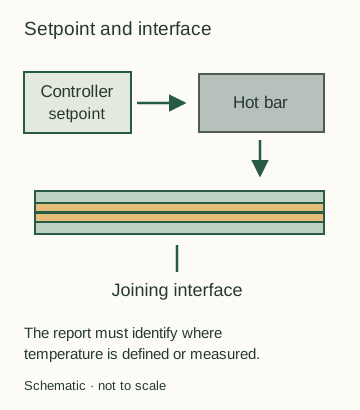
The diagram identifies locations, not an amount of heat transfer or a recommended setting. No temperatures are plotted because this publication has no material-specific measurements to justify a curve.
Evaluate hot behavior and cooled performance separately
A seal that develops strength after cooling may still need evaluation while the package is handled immediately after formation. RDM’s explanation distinguishes hot tack from cooled seal strength. Record which condition a result describes rather than calling both simply “seal strength.”
For the line trial, ask the technical team to define acceptable results across representative conditions, not just at one favorable setpoint. Include starts and restarts, normal material variation and the pack’s immediate downstream handling. Keep the material and machine within their approved limits. Raising temperature to mask every defect can leave contamination, misalignment or another cause unresolved.
Turn the result into a release record
Retain the laboratory report as input, the trial samples as observations and the released process conditions as the decision. Link each to the material revision and product. The film-change checklist provides the wider record; materials and machinery explains where sealing fits in the change.
This article offers a report-reading and trial-planning method, not a laboratory procedure or a production recipe. Illustrations show generic packaging and a schematic heat path, not measured results. Checked October 2026.